



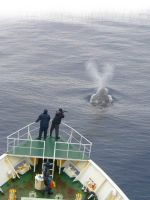


The Whale Problem
What whales reveal about conservation, money and the way we value nature
Veer Supunya Devavrata
Ahead of the International Whaling Commission's 70th meeting in Hobart, the old argument over whaling is returning in a new form. Industrial whaling taught us what happens when human appetite outruns biology. But what happens when conservation works, populations recover and science says some use may again be sustainable? Drawing on IWC science, IPBES1 work on sustainable use and the diverse values of nature, and new discoveries from the Indian Ocean, Veer Supunya Devavrata examines a more uncomfortable question: when does protecting wildlife become a matter of conservation science, and when does it become a matter of our own values?
1 IPBES stands for the Intergovernmental Science-Policy Platform on Biodiversity and Ecosystem Services, an independent intergovernmental body established in 2012 to bridge the gap between science and policy for biodiversity. https://www.ipbes.net/.
There are dead whales at the bottom of the Indian Ocean. Quite a lot of them, apparently.
Earlier this year, scientists reported finding a remarkable concentration of whale remains across roughly 1,200 kilometres of the Diamantina Zone, between Australia and Antarctica. They found modern whale falls and hundreds of fossil cetaceans, some going back millions of years. When a whale reaches the bottom, an entire world gets to work. Scavengers arrive, followed by worms, molluscs and bacteria. Eventually the bones themselves become habitat. A single carcass can sustain life long after the whale has ceased to be recognisable as one.
I came across the research while preparing for the International Whaling Commission meeting in Australia and enjoyed the timing. We have spent decades arguing about whether humans should kill whales. Nature, meanwhile, has been recycling them for millions of years.
“Worms eat them anyway” would admittedly make a poor intervention at an international convention. But the discovery stayed with me because it complicated something I had taken for granted about whales..
I grew up, like most people of my generation, with a fairly straightforward understanding of them. Whales were magnificent, intelligent and vulnerable. Humanity had hunted them nearly to extinction until environmentalists, scientists and governments eventually did something about it. Somewhere between school textbooks, wildlife documentaries and the familiar image of a tail disappearing beneath a perfect blue sea, a moral equation established itself: killing whales was bad; saving whales was good.
Much of that story is true, and we should be grateful for the people who changed it. Industrial whaling was devastating. Steamships, explosive harpoons and factory vessels stripped away much of the protection once offered by distance, speed and the sheer size of the ocean. Some whale populations were reduced to fractions of their former abundance.
I have never understood why advocates of sustainable use sometimes become defensive about histories like this. Unsustainable exploitation is not evidence against sustainable use. It is evidence for why the first word matters. A renewable resource remains renewable only while our appetite stays within its biological limits. Call it whaling, fishing, forestry or hunting; the mathematics is wonderfully indifferent to ideology.
The International Whaling Commission progressively restricted catches before adopting the 1982 decision that resulted in commercial catch limits being set at zero from the 1985/86 season. “Save the whales” became one of environmentalism's great victories.
Then came the awkward part.
Some whale populations recovered.
Not the whales. There is no population called “the whales,” any more than there is a population called “the fish.” Species differ, populations differ and threats differ. Some whales remain in serious trouble. Others are in a biological position that bears little resemblance to the crisis that produced the modern anti-whaling movement.
What interests me is what the IWC did next. After the moratorium, its Scientific Committee spent eight years developing the Revised Management Procedure, eventually adopted in 1994. The RMP was designed specifically to estimate sustainable commercial catch limits for baleen whales while accounting for the considerable uncertainty inherent in whale science. Conservation was given the greatest priority, including a rule allowing no catch from stocks below 54 per cent of estimated carrying capacity.
The RMP was not subsequently implemented for setting IWC commercial catch limits. The Commission had decided that it should operate only as part of a wider Revised Management Scheme, including monitoring and compliance measures; negotiations over that scheme eventually reached an impasse.
There is something wonderfully revealing about that history. The world's principal institution for whale conservation did not conclude that sustainable harvest was scientifically impossible. It developed a deliberately conservative scientific mechanism for calculating it. The unresolved argument was therefore larger than population biology alone: not simply what humans could remove without compromising a population, but under what circumstances they should be allowed to do so.
That distinction between can and should sits at the heart of the whale debate, and science becomes less useful once we cross it. Science can estimate abundance, uncertainty and risk. It can tell us that one population is depleted while another may withstand some mortality. It cannot tell us whether eating a whale is morally acceptable.
That is a question of values.
The whale on the plate
Imagine two meals. One contains fish from a healthy, well-managed fishery. The other contains whale meat from a healthy population harvested within a scientifically determined limit.
For many of us, myself included, those two plates do not initially feel the same. Intelligence might explain it, except that pigs are remarkably intelligent, and this has done little to dent humanity's enthusiasm for pork. Sentience doesn't get us much further; octopuses complicate that argument before we've even left the seafood menu. Longevity, family bonds, ecological importance - almost every apparently objective distinction begins to wobble when applied consistently.
Which suggests that the difference may not be in the whale at all. It may be in us.
During the twentieth century, the whale underwent perhaps the greatest rebrand in wildlife history. An animal associated with oil, meat, bone and industry became associated with song, intelligence, family and wilderness. Television brought whales into homes that had never seen an ocean. Environmental organisations turned their protection into one of conservation's most recognisable causes.
That transformation helped save them. It also changed the terms of the argument.
The strongest case against industrial whaling had been biological: populations were being destroyed. As some populations recovered and scientific management became more sophisticated, opposition increasingly incorporated another proposition - that whales simply should not be killed.
There is nothing illegitimate about that position. Animal rights is a moral philosophy, and moral philosophies are allowed to have conclusions.
The trouble begins when we confuse it with conservation science.
If a population will decline under harvest, that is a conservation argument. If a killing method produces unacceptable suffering, that is a welfare argument. If the position is that humans should not deliberately kill whales regardless of abundance, that is an animal-rights argument.
They can overlap without being interchangeable.
Money makes the distinction particularly interesting.
Money never left the whale
Commercial whaling is often discussed as though attaching economic value to whales is itself part of the problem. Yet money never really left the whale.
It just changed boats.
Once it followed whales aboard factory ships. Today it follows them aboard whale-watching vessels, through documentaries, tourism campaigns, conservation appeals and fundraising drives. There is nothing inherently wrong with that. Creating economic value around living wildlife can be an excellent conservation mechanism. But it makes the language surrounding commercial use rather curious. Economic value attached to a harvested whale is frequently treated as morally contaminating, while economic value attached to watching, photographing or campaigning around the same animal is celebrated.
Perhaps our objection was never really to monetising whales. We simply developed strong opinions about which forms of value were acceptable to monetise.
A whale-watching company is commercial. A wildlife documentary is commercial. Conservation organisations can quite legitimately raise money around protecting whales. None of this tells us whether commercial whaling should exist, but it does mean that “commercial” cannot sensibly be used as a synonym for “unsustainable.”
This matters because animal-rights organisations are entitled to argue that whales possess rights that make deliberate killing unacceptable regardless of population status. What is less convincing is allowing that moral position to borrow the language of extinction or conservation when the biological evidence for a particular population says something different.
If the objection is ethical, make the ethical case. It may be a powerful one.
But name it correctly.
Nature has more than one value
My work with IWMC around IPBES has made me think about this distinction differently.
In 2022, IPBES completed major assessments on the sustainable use of wild species and on the diverse values and valuation of nature2. Behind the spectacular ability of international institutions to make fascinating ideas sound bureaucratic sits a fairly radical proposition: human beings do not have one relationship with nature.
We fish, hunt, gather, watch, photograph, study, protect and trade wild species. For many Indigenous peoples and local communities, these relationships are tied to food, culture, identity and place. Nature can possess intrinsic value while simultaneously carrying cultural, relational and material value.
Whales make this wonderfully difficult.
One person sees an intelligent individual that should never be deliberately killed. Another sees an animal embedded in a cultural relationship stretching across generations. Someone else sees food. Another sees tourism income. A scientist may see all of this while also seeing an abundance estimate and a reproductive rate.
None of those values alters biology. If a population cannot withstand harvest, culture cannot make the arithmetic disappear. Economics cannot negotiate with reproduction and politics cannot vote an extinct population back into existence.
Nature gets a vote.
But once biology tells us that a population can withstand a particular level of use, science has completed only part of the conversation. What remains is a discussion about which relationships with that animal society considers legitimate.
That question becomes particularly uncomfortable when one culture has enough political power to make its preferred relationship with nature universal.
The IWC already lives with this complexity. Aboriginal Subsistence Whaling operates under scientifically informed catch limits, recognising nutritional and cultural needs while maintaining conservation safeguards. Indigenous communities continue to hunt whales within this system.
So we have already accepted the apparently contradictory proposition that a whale can be conserved, respected, culturally important and killed.
The real disagreement is over the circumstances in which that relationship is legitimate.
And then there is the ocean economy surrounding all of this.
The IWC estimates that at least 300,000 cetaceans are killed through fisheries bycatch every year. Whales, dolphins and porpoises drown in nets or become entangled in fishing gear; larger whales may survive initially only to tow gear that impairs feeding, cuts into their bodies and eventually kills them. The IWC describes bycatch as the single most serious direct threat to cetaceans globally.
There is something peculiar about directing enormous moral energy toward the intentional harvest of whales while hundreds of thousands of cetaceans can disappear each year into the machinery of an ocean economy most of us participate in without much thought.
This does not justify killing another whale. It simply asks us to be consistent about why a whale's death matters. If our concern is welfare, an animal dying slowly in fishing gear matters. If our concern is conservation, population-level mortality matters regardless of whether the animal was targeted. If our concern is instead that deliberately killing a whale is inherently wrong, that is a different conversation.
Once again, the whale has a habit of revealing our values.
2 See IPBES ICT Guide. Assessment Directories: https://ict.ipbes.net/ipbes-ict-guide/data-and-knowledge-management/assessment-directories.
Hobart
This September I will travel to Hobart for the 70th meeting of the International Whaling Commission where I will represent IWMC (Integrating Wildlife, Markets and Conservation).
Among the resolutions on the 2026 agenda is one titled “Resolution for the Implementation of a Conservation and Management Program for Whale Stocks aimed towards the Sustainable Use of Whale Resources.” The same meeting will deal with vessel strikes, incidental catches, strandings and a proposed South Atlantic Whale Sanctuary.
I don't find the coexistence of those subjects contradictory. A conservation institution ought to be capable of protecting a depleted population while considering whether an abundant one can support use. It should worry about animals killed accidentally as well as deliberately, and it should be able to consider welfare, culture, science and economics without pretending that any one of them makes the others disappear.
Sustainable use, meanwhile, should be an irritatingly difficult standard to meet. The population must be healthy, the science credible, the harvest monitored, welfare taken seriously and the institutions capable of enforcing limits. Other sources of human mortality have to be included in the calculation. Most importantly, use has to stop when the biological conditions that justified it no longer exist.
Where those conditions cannot be met, there is very little to argue about. Where they can, however, we should be honest about what remains. The disagreement may no longer be primarily about conservation biology. It may be about culture, ethics, rights and the kinds of relationships with nature that we have decided are acceptable.
My generation inherited “Save the Whales.”
We should be grateful for it. Previous generations taught us, at enormous ecological cost, what happens when markets and technology outrun biology. There is nothing progressive about forgetting that lesson.
But perhaps they left us the harder part.
They had to work out how to stop killing too many whales. We have to work out what conservation means when some populations recover, when science improves, and when the rules created during a period of scarcity encounter a period of abundance.
That does not mean those rules suddenly become wrong. It means their purpose remains open to examination. Conservation ought to be capable of responding to recovery as intelligently as it responds to decline.
It also means accepting that an animal can be loved and used at the same time, because humans have been doing exactly that for most of our history. Respect does not mean the same thing in every culture, and the relationship preferred by an urban society thousands of kilometres away is not automatically more enlightened than the relationship of people who actually live with, depend upon or consume a wild species.
I don't expect Hobart to settle any of this. International meetings rarely resolve humanity before lunch.
But somewhere south-west of Australia, kilometres beneath the Indian Ocean, those dead whales will continue feeding other lives. They were doing so long before the first factory ship sailed and will presumably continue long after our arguments about whales have changed again.
I keep returning to them because they offer a useful correction to the way we sometimes think about conservation. Nature is neither a museum nor a morality play. A whale can be magnificent and mortal. It can be intelligent and edible. It can be culturally sacred to one person and culturally important as food to another. None of those descriptions tells us whether taking one from a particular population is sustainable.
For that, we still need science.
And perhaps that is where I land before Hobart. We were right to stop pretending the oceans were inexhaustible. We were right to protect whale populations that our own appetites had devastated. But if conservation succeeds, success should leave us capable of recognising the difference between an animal we must not use because we cannot sustain its use, and an animal we have decided we must not use because we no longer approve of using it.
Both are choices a society is entitled to make.
Only one is a conclusion of conservation science.
I think we owe whales-and each other-the honesty to know which argument we are making.
4 September 2026.
The Whale Problem - PDF file