The Institute of Cetacean Research




Mid-Term Review Workshop for the Japanese Abundance and Stock-structure Surveys in the Antarctic (JASS-A)
December 2, 2025
Designated Corporation for Scientific Whale Research
THE INSTITUTE OF CETACEAN RESEARCH
Background
Large-scale commercial whaling conducted by nations including Britain and Norway during the first half of the 20th century drastically reduced the populations of large whales in the Southern Hemisphere. Consequently, an excess of Antarctic krill, their prey species, emerged. This situation allowed Antarctic minke whales, which were not targeted by commercial whaling, to take advantage of its abundance. Japan's consecutive whale research programs (JARPA, JARPA-II, NEWREP-A) have revealed that this led to ecological changes in the species, including a rapid increase in population size and a decrease in the age at sexual maturity. These surveys, conducted under consistent methodologies through continuous visual observations, have also yielded results suggesting that since the late 1990s, humpback and fin whales - which compete with Antarctic minke whales for prey - have experienced a rapid recovery in their populations, while the nutritional status of Antarctic minke whales has deteriorated. Furthermore, the impact of the increase in large whales has been confirmed to be causing a trend for Antarctic minke whales to shift their habitat further south within the sea ice area. Thus, it has become clear that the Antarctic Ocean ecosystem, centered on cetaceans, has undergone significant changes even since the start of the 21st century.
The JASS-A Research Program
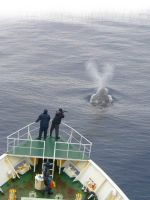
The Japanese Abundance and Stock-structure Surveys in the Antarctic (JASS-A), a continuation of the Japanese government's research program (non-lethal research) in the Antarctic Ocean, is implemented by the Institute of Cetacean Research. The survey plan is formulated by the Government of Japan and planned and implemented by the Institute with the approval of the Japanese Government. The main research objectives are (1) Study of abundance and their trends of large whale species in the Antarctic Ocean, and (2) Study of the distribution, movement, and stock structure of large whale species in the Antarctic Ocean. Research is also conducted on physical oceanography, marine debris, and cetacean ecology. Surveys are based on systematic sighting surveys using methods employed by the International Whaling Commission (IWC) Scientific Committee. They are conducted during the Southern Hemisphere summer using one or two dedicated vessels in the IWC Antarctic management areas III, IV, V, and VI, south of 60°S (covering two-thirds of the Antarctic Ocean). The JASS-A research program commenced in the 2019/2020 season and is planned for a total of eight seasons (2019/2020 to 2026/2027), with overseas researchers also contributing to the surveys by participating onboard.
The Mid-Term JASS-A Review Workshop
This workshop was held in Tokyo from 20 to 22 October 2025. The workshop objectives were: (i) to evaluate the research results achieved to date (2019/2020 - 2024/2025) in relation to the primary and secondary objectives of JASS-A; and (ii) to discuss recommendations for future fieldwork and analytical research, aiming to achieve the primary and secondary objectives of JASS-A by the program's final review (following the final survey in 2026/2027). The meeting was attended by five invited scientists (two from Norway, one each from the UK, Germany, and South Africa) which are leading experts in cetacean research, alongside 24 Japanese scientists. Discussions, centered on a total of twenty-eight research papers produced to date under JASS-A.
JASS-A's Research Results
After the Antarctic whale research programs (post-2020), the population of Antarctic minke whales has shown a declining trend. Conversely, the populations of fin whales and humpback whales continue to demonstrate a clear increasing trend, albeit with regional variations, while a gradual recovery has also been observed in the population of blue whales. The distribution area of humpback whales in the Antarctic Ocean has further expanded, and it has been confirmed that the Antarctic minke whales have been pushed to the vicinity of the Antarctic continent, where there is a tendency now for them to distribute in high-densities. Genetic research has yielded new findings regarding the Antarctic minke whale, confirming the presence of genetically distinct groups in the eastern and western parts of the survey area, as observed previously. Conversely, new results have been obtained suggesting that the fin whale and the blue whale respectively constitute a distinct genetic group throughout the entire Antarctic Ocean. Furthermore, data from satellite tags attached to the whales has yielded crucial information regarding the previously unknown northern migration route of the Antarctic minke whale, possibly leading to the identification of its breeding grounds. Research from JASS-A suggests that the Antarctic Ocean ecosystem continues to undergo change, and that to manage whale resources appropriately, it is vital to ascertain the state of these resources and to monitor these changes effectively.
Evaluation from Invited Overseas Scientists
At this workshop, the JASS-A surveys received extremely high praise from all invited overseas scientists, who recognized them as invaluable for the continuous monitoring of the Antarctic Ocean ecosystem, particularly its whale populations, and deemed the associated research to be of significant importance. Furthermore, it was strongly recommended that surveys be conducted in currently unsurveyed areas (one-third of the Antarctic Ocean) to enable comprehensive management of Antarctic whale resources, and that whale monitoring in the Antarctic Ocean should continue beyond the planned eight-year survey period.
Summary
・A mid-term review workshop was held from 20 to 22 October, inviting overseas scientists to evaluate the progress of the Japanese Abundance and Stock-structure Surveys in the Antarctic (JASS-A).
・The review by overseas scientists resulted in the JASS-A research being highly commended.
・For the future, it was strongly recommended that the JASS-A program be continued and the survey area expanded to ensure ongoing whale resource monitoring in the Antarctic Ocean.

JASS-A Mid-Term Workshop (Tokyo, Japan).
Mid-Term Review Workshop for the Japanese Abundance and Stock-structure Surveys in the Antarctic (JASS-A) (PDF file)