The Institute of Cetacean Research

- You are here:
- Home>
- English Sitemap>
- RESEARCH>
- Ongoing Research>
- Stranding Survey




Stranding Survey
Historical stranding records
The Institute of Cetacean Research (ICR) has been recording strandings of marine mammals on the Japanese coast since 1996 (Figure 1), with the purpose of obtaining information on their migration and distribution through the record and analysis of samples collected from the stranded animal. Genetic analyses based on samples from stranded whales have contributed to studies on taxonomy and stock structure of stranded cetacean species.
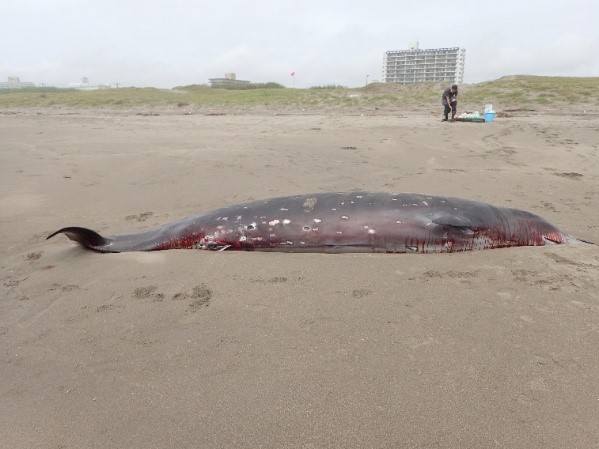
Figure 1. ICR scientists conducting biological surveys on a stranded Stejneger's Beaked Whale.
The ICR compiles information on stranding received from researchers, government officials or the public who send the information following a protocol and record sheet developed and distributed by the ICR among Japanese coastal prefectures, or from other sources such as newspapers. Together with the stranding record sheet, people are requested to send skin or muscle samples for genetic analysis. The ICR corroborates species identity by DNA analysis. See details on the protocol and data sheet in: http://www.icrwhale.org/pdf/stranding.pdf .
Stranding records from 1996 to 2015 are available in: http://www.icrwhale.org/zasho2.html. Data and samples from strandings are available to interested scientists under the data access protocol of the ICR.
Since the start of the 'Response to Large Whale Strandings' project ('Yori Kujira' project) in 2021 (see below), the ICR stranding record system has focused on marine mammals other than large whales.
Response to Large Whale Standings Project (Yori Kujira Project)
Since June 2021 a project named ‘Response to Large Whale Standings' or 'Yori Kujira' was started, which is similar in operational mode to the stranding record system described above but focused only on large whales (baleen whale species, sperm whale and Baird beaked whale) and emphasizing the collection of data and samples useful for management. Such a task was entrusted to the Institute of Cetacean Research (ICR) and the Japan Association of Aquariums (the implementing body) by the Government of Japan (Fisheries Agency of Japan, FAJ) as an outsourced program. After 2022, this is entrusted to the ICR by the FAJ every year.
The main objective of this project is the collection of biological samples from stranded large whales, which can be used to complement whale resource management in Japan. Scientists from the implementing body participate in the field work to collect the following data and samples from stranded whales (Figure 2): i) whale species; ii) body length; iii) gender; iv) external photographs and other morphological information; v) ovaries or testis for determining sexual status; vi) samples for age determination (teeth, earplugs, eyes); vii) tissues for genetic and contamination analysis (skin, blubber, muscle); viii) others.
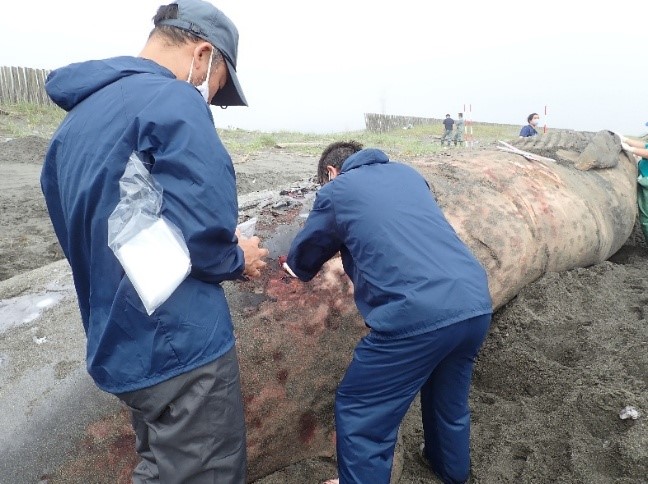
Figure 2. Scientists from the ICR collecting samples from a stranded Bryde's whale as part of the 'Yori Kujira' Project.
At the start of the project a letter was sent by the implementing body to relevant prefectural government officials explaining the objectives and asking for cooperation in the implementation of the project. Specifically, the collaborating institutions asked the prefectural officials to contact them in cases of stranding events and cooperating with the implementing body during the surveys.
The implementing body also specified the conditions for conducting research on the stranded whales by scientists from external institutions. These conditions were the following: i) they should agree with the purpose of the whole research project; ii) during the field research activities, they will be under the command of a research leader designated by the implementing body; iii) if additional specimen collection or research items are desired by them, a research proposal must be submitted and only those items approved by the implementing body can be carried out. The external scientists must bear the additional costs involved; iv) the samples and data obtained from the whale surveyed must not be sold or transferred to a third party for commercial purpose; v) the implementing body must respond to media outlets and promptly organize and publish the survey data.
The stranding events under the ‘Yori Kujira’ project are listed on an annual basis at the Home Page of the ICR since 2021.
Information on stranding of small and large cetacean under the ICR stranding records system and 'Yori Kujira' project are reported to the International Whaling Commission's Scientific Committee (IWC SC) and North Atlantic Marine Mammal Commission's Scientific Committee (NAMMCO SC) annual meetings on a voluntary base as Progress Reports on Cetacean Research.